
CJC-1295 No DAC
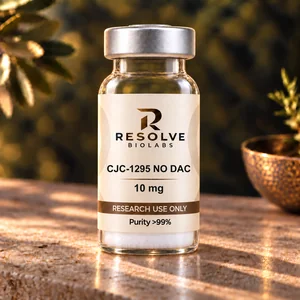
CJC-1295 without DAC
CJC-1295 without DAC is a modified version of the first 29 amino acids of growth hormone-releasing hormone. It is widely known as Modified GRF (1-29), or Mod GRF 1-29. Four amino acids in the native sequence are swapped for alternatives that resist enzymatic cleavage, extending its stability compared with sermorelin while keeping the same receptor target.
DAC versus no DAC
“DAC” stands for drug affinity complex, a chemical linker that lets a peptide bind to albumin in circulation and persist far longer. The version on this page does not carry that linker. Researchers choose between the two depending on whether they want to model short, pulse-like receptor activation or sustained exposure. Resolve stocks the version without DAC.
Research interest
Mod GRF (1-29) has been investigated in animal and pituitary-cell models of growth hormone secretion. It is frequently studied alongside growth hormone secretagogues that act on a different receptor, such as ipamorelin or GHRP-6, because the two classes engage separate pathways that converge on the same output. That pairing is a common topic in the endocrine research literature. Studies of receptor binding and stability have also used it to show how a handful of substitutions can protect a peptide from cleavage by dipeptidyl peptidase-4.
Choosing a strength
The product card above is a lyophilized vial with several strengths in its option selector. Content per vial is printed on the label. Other GHRH-family peptides in the catalog include sermorelin and tesamorelin, and growth hormone secretagogues include ipamorelin and GHRP-6, which helps if a study compares mechanisms.
Verify the lot
Look for the lot code on the vial and find its certificate of analysis among our COA / Lab Reports. Make sure the report names the no-DAC version specifically, since the two forms are easy to confuse. Reports are still being added; until yours appears, our support team can confirm details.
Reserved for in-vitro work and other laboratory research.