
KLOW Blend
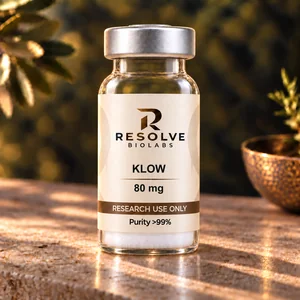
KLOW: Four components in one vial
KLOW extends the GLOW formula with a fourth research peptide. Each vial combines GHK-Cu, BPC-157, TB-500 and KPV as a lyophilized powder, giving laboratories a single preparation that spans several areas of peptide research.
The added piece: KPV
KPV is a tripeptide, lysine-proline-valine, that corresponds to the final three amino acids of the pigment-related hormone alpha-MSH. It has been investigated in cell and rodent models of intestinal and skin inflammation, often with a focus on NF-kB signaling. Its inclusion is what separates KLOW from GLOW.
The other three
GHK-Cu is a copper-binding tripeptide studied in fibroblast culture for its effects on matrix-related gene expression. BPC-157 is a fifteen-residue peptide drawn from a gastric protein fraction and examined in animal models of soft-tissue and gut-lining repair. TB-500 is modeled on the actin-binding portion of thymosin beta-4, a protein tied to cell movement.
Why researchers use blends like this
Combination products answer a practical need: running one preparation instead of four, with a ratio that stays fixed between lots. They also raise their own scientific questions, since interactions between components are not well mapped in the literature. Many groups pair a blend with single-compound controls; GHK-Cu, BPC-157, TB-500 and KPV are each listed separately in the Resolve catalog for that reason.
About the KLOW listing
KLOW is sold as a vial only. The label states total peptide content, and the product page breaks down the component amounts. If you need a capsule format, the closest relative is GLOW capsules, which omit KPV.
Checking your lot
With four components, a certificate is worth reading closely: compound names, quantities and lot should all agree with your vial. Take the lot code from the label and search for it among the documents in COA / Lab Reports. Those documents are being uploaded on a rolling basis.
Strictly a laboratory research product. Not for human consumption.