
GHK-Cu
Copper and a three-residue peptide
GHK-Cu is the tripeptide glycyl-L-histidyl-L-lysine (GHK) complexed with a copper(II) ion. GHK was first isolated from human plasma in the 1970s, and its strong affinity for copper is what gives the complex its characteristic blue color in solution. It is one of the smallest peptides in the Resolve catalog and one of the most widely studied.
Lines of investigation
Laboratory work on GHK-Cu has centered on cultured fibroblasts and keratinocytes, where researchers have looked at collagen and elastin synthesis, extracellular-matrix remodeling and changes in gene-expression profiles. Rodent wound models have also been used. Because copper itself is biologically active, well-designed studies often include controls that separate the effect of the metal from that of the peptide.
What sits in this grid
GHK-Cu shows up in five different Resolve products:
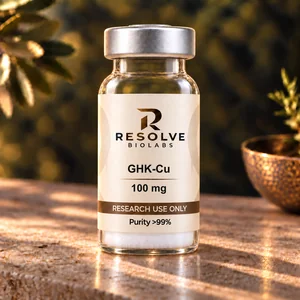
- GHK-Cu vial: lyophilized copper peptide; select the strength from the listing’s options.
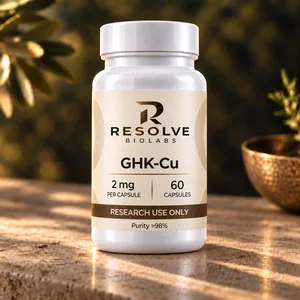
- GHK-Cu capsules: a stated quantity of GHK-Cu in each capsule, plus a count per container.
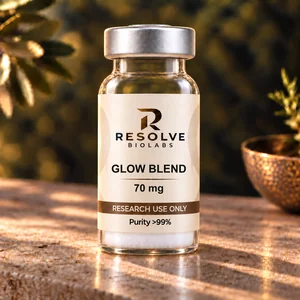
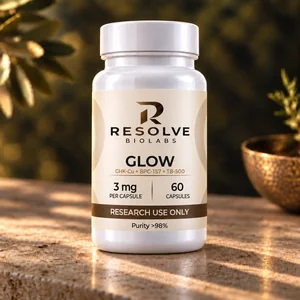
- GLOW vial and GLOW capsules: GHK-Cu blended with BPC-157 and TB-500.
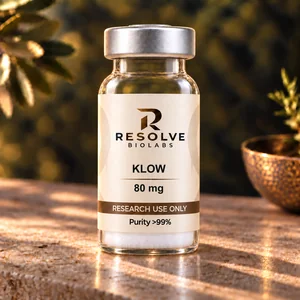
- KLOW vial: the GLOW trio plus KPV.
The standalone vial and capsules are the clearest fit for work focused on the copper peptide alone. The blends serve labs comparing combinations, and keeping a single-compound GHK-Cu product on hand makes a convenient reference arm.
Handling note
Copper complexes can be sensitive to light and to strongly chelating buffers, so note storage conditions in your records alongside the lot number.
COA lookup
Your container is printed with a lot code. That code is the key to finding its certificate, which will sit under COA / Lab Reports once released. We are filling that list in report by report. Check that the compound, quantity and lot shown on the certificate all agree with your label before use.
Offered by Resolve BioLabs solely for laboratory research.