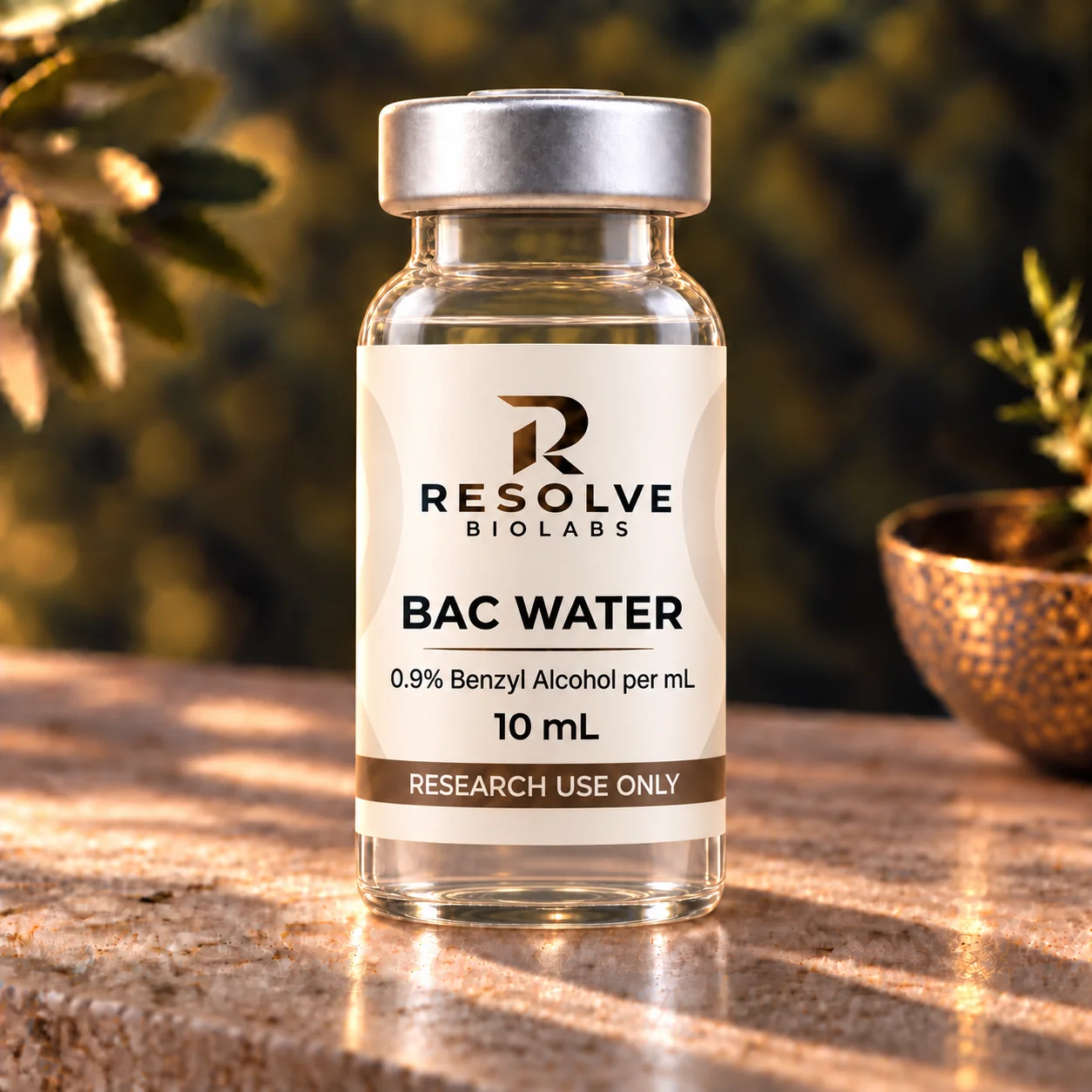
Peptide Vials
Bacteriostatic Water
Bacteriostatic water is sterile water containing a benzyl alcohol preservative, used to reconstitute lyophilized research peptides. 10 mL multi-draw vial.
Identity & storage
- CAS number
- N/A for the mixture. Water: 7732-18-5; benzyl alcohol: 100-51-6.
- Molecular weight
- N/A for the mixture. Water: 18.02 g/mol; benzyl alcohol: 108.14 g/mol.
- Storage
- Store according to the temperature and after-opening instructions on the product label. Protect from direct light. Do not freeze.
✓ In stock and ready to ship
Certificate of analysis View available reports and lot details
Bacteriostatic Water
Product identification & intended use
SKU: RB-VIAL-BACWATER-10ML
For laboratory research use only. Not for human or veterinary use.
Description
Bacteriostatic water is sterile water that contains a small amount of benzyl alcohol as a preservative. The preservative suppresses bacterial growth after the stopper is punctured, which is why laboratories use it to reconstitute lyophilized peptides that will be drawn from more than once. Resolve BioLabs supplies bacteriostatic water in a 10 mL vial.
What is Bacteriostatic Water?
Standard bacteriostatic water contains 0.9% benzyl alcohol (9 mg per mL) in sterile water. “Bacteriostatic” means it inhibits bacterial growth rather than killing all organisms outright — the preservative is what allows a vial to be accessed multiple times, unlike single-use sterile water. Check the label and COA of your lot for its exact composition.
Bacteriostatic water vs sterile water
Sterile water has no preservative and is intended for single use; once opened, it should be discarded. Bacteriostatic water is intended for multiple draws over a limited period. Some compounds are sensitive to benzyl alcohol, so always confirm compatibility with your protocol.
Bacteriostatic Water specifications
| Contents | Sterile water with benzyl alcohol preservative |
|---|---|
| Typical preservative level | 0.9% benzyl alcohol |
| Volume | 10 mL |
| Container | Multi-draw vial with rubber stopper |
| Use | Reconstitution of lyophilized research materials |
| Catalog reference | RB-VIAL-BACWATER-10ML |
How laboratories use bacteriostatic water
Lyophilized peptides are supplied as dry powder because they are far more stable that way. To prepare them for an experiment, researchers add a measured volume of diluent to the vial. The concentration of the resulting solution is simply the peptide mass divided by the volume of water added — for example, 10 mg of peptide in 2 mL of water gives 5 mg per mL. Adding the water slowly down the inside wall of the vial, rather than directly onto the powder, and swirling gently instead of shaking helps avoid foaming and peptide damage.
Format, storage and handling
Store according to the temperature and after-opening instructions on the product label. Protect from direct light. Do not freeze.
Testing and documentation
Available reports describe the samples tested. Match the compound, format, strength and lot identifier with your supplied label; a supplier report does not by itself verify current stock. See the report library.
Related research compounds
Every peptide vial in the catalogue is lyophilized — including BPC-157, GLP-3, GHK-Cu, ipamorelin and sermorelin. Browse all peptide vials.
Bacteriostatic Water FAQ
What is bacteriostatic water used for?
In research it is used to dissolve (reconstitute) lyophilized peptides and other powders into a solution.
Is bacteriostatic water the same as sterile water?
No. Bacteriostatic water contains benzyl alcohol so it can be accessed several times; sterile water has no preservative and is single-use.
Do capsules or sprays need bacteriostatic water?
No. Capsules and liquid sprays are ready to use. Only lyophilized vials need reconstituting.
For laboratory research use only. Not for human or veterinary use. Not a drug, food, cosmetic or dietary supplement, and not intended to diagnose, treat, cure or prevent any disease.